
Treatments /
Dental implants: why a missing tooth isn’t just about looks
 Dr. Vanessa MachucaPediatric dentistry · Dentalist Kids3 min read
In short
- When you lose a tooth, the bone starts to resorb and the neighboring teeth shift.
- Before the final crown, the bone generally needs three to six months to bond with the implant.
- You need enough bone and healthy gums; smoking greatly increases the risk that it fails.
“It’s a molar way in the back, you can’t even see it, and I chew just fine.” That’s the line behind most postponed tooth replacements, and it’s understandable: if it doesn’t bother you and nobody notices, it doesn’t feel urgent.
The problem is that what happens after you lose a tooth doesn’t happen in your smile. It happens in the bone, silently, and it doesn’t stop on its own.
What happens in the gap
The bone around a tooth exists because that tooth is there. Every bite sends stimulation through the root, and that stimulation is the signal that keeps the bone alive. When the root is gone, so is the signal, and the bone starts to resorb, or shrink away. The loss is fastest during the first year.
Two other things happen at the same time. The neighboring teeth, which used to lean on each other, start tilting into the empty space. And the tooth in the opposite jaw, with nothing to bite against, slowly over-erupts, moving out little by little until it’s out of position.
The result is that the gap from a single molar, left for years, ends up involving three or four more teeth and bone that no longer has the volume it used to. That’s why timing matters: dealing with it at six months isn’t the same as dealing with it at six years.
What an implant is
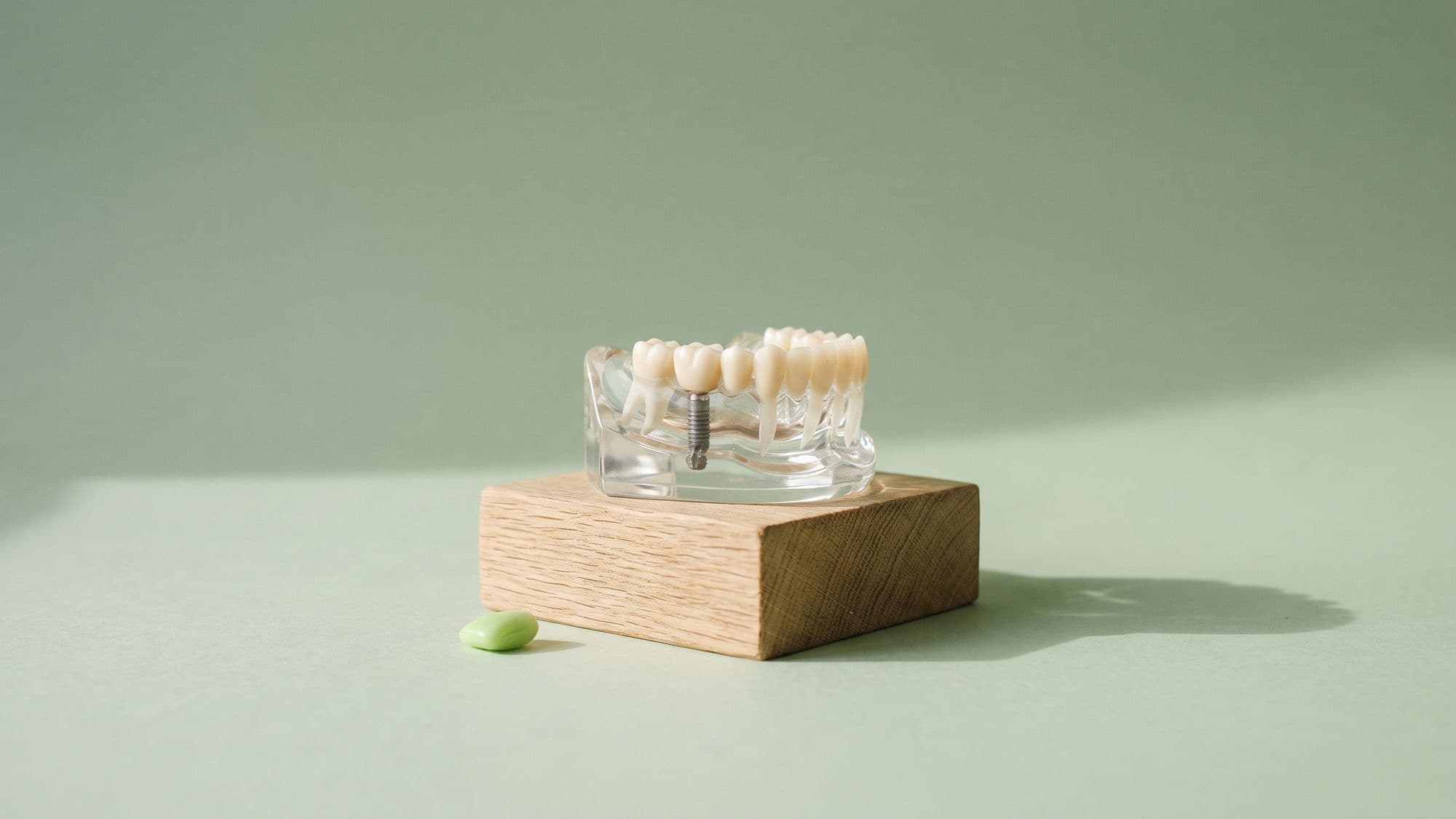
An implant isn’t one tooth: it’s three pieces. A titanium screw that replaces the root and goes into the bone; an abutment that sticks out above the gum; and on top, the crown, which is the only part you see and is made to match the color of your teeth.
What makes it work is something called osseointegration: the bone grows against the titanium surface until it’s bonded to it. It’s not a screw that’s been tightened; it’s a screw the bone has fused with. And that takes biological time that can’t be rushed.
The real timeline
It’s worth being frank here, because “teeth in a day” advertising causes a lot of confusion.
After the screw is placed, it generally takes three to six months of osseointegration before the final crown can go on. If a bone graft was also needed, add months. There are immediate-loading cases, where a temporary crown is placed the same day, but they depend on having enough bone and good initial stability: they’re a possibility, not the rule.
If someone promises you the whole process in a week without ever looking at a CT scan of your jaw, be wary.
Who’s a good candidate
The evaluation looks mainly at these things:
- Enough bone volume and quality, assessed with a CT scan, not by eye.
- Healthy gums. Active gum disease has to be treated first: the implant can be lost the same way the tooth was.
- Well-controlled health conditions. Diabetes doesn’t rule you out, but when it’s uncontrolled it compromises healing.
- Tobacco. Smoking significantly increases the risk of failure, and this is one of the few things that’s entirely in your hands.
- Growth that’s finished. In teenagers we wait, because the bone keeps growing and the implant doesn’t.
What to weigh
Today, an implant is the option that best mimics a natural tooth, and it has one important advantage over a traditional bridge: it doesn’t require grinding down the healthy teeth next to it.
In exchange, it costs more, takes months and requires surgery. And it needs the same upkeep as a tooth: it gets cleaned the same way and checked the same way, and it can develop inflammation around it—peri-implantitis—if it’s neglected. An implant isn’t indestructible; it’s something you also have to take care of.
If you’re deciding, the useful question isn’t “Should I get an implant?” but “What are my options for this gap, what does each one cost, and what happens to my bone if I do nothing this year?” That last part is the one almost nobody asks, and the one that matters most.
Written by
Dr. Vanessa Machuca
Pediatric dentistry specialist. With years of experience in dentistry, she’s dedicated to sharing what she knows to improve her patients’ dental health.
View profile